

We have not tested these products. This comparison is reasoned from manufacturer specifications, documentation and warranty terms. How we test
If you buy through a link on this page we may earn a commission. Retailers do not pay for reviews or placement. Prices are shown as bands, never as figures — the live price is at the retailer. As an Amazon Associate I earn from qualifying purchases. How we make money
On this page
The short version
Fully modular at a price where semi-modular is normal, which settles the argument.
See at Amazon — Corsair RM750e (opens in a new tab)The cheaper modular option when quiet matters more than the last watt of capacity.
See at Amazon — be quiet! Pure Power 12 M (opens in a new tab)The modular question is usually presented as a matter of tidiness. In a large case it is. In a small one it is an airflow decision, which is a different argument with a different answer.
What you are actually buying
A non-modular supply has every cable permanently attached, including the ones your build does not use. Those cables do not disappear. They get folded and stored somewhere inside the case, and in most cases that somewhere is behind the motherboard tray or in front of the intake fans.
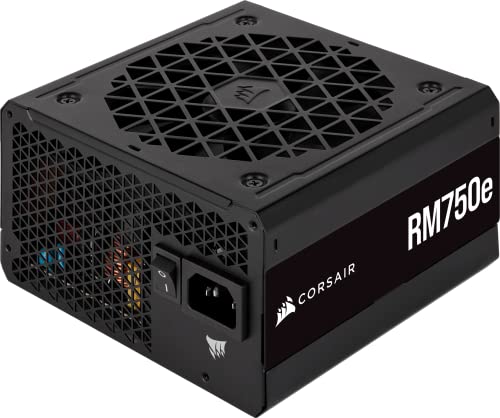
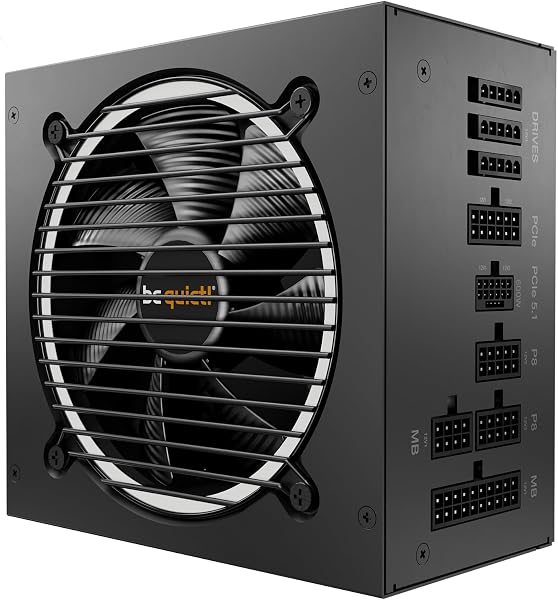
A modular supply lets you leave them in the box. The Corsair RM750e (at Amazon, opens in a new tab) is a common example of a fully modular unit at a price where semi-modular used to be the default, and the be quiet! Pure Power 12 M (at Amazon, opens in a new tab) keeps the format available at a more modest budget. Cable style is one of the things our power supply recommendations weigh.
When the premium is worth paying
Small cases: yes, clearly. Compact builds have no cable compartment worth the name, and a bundle of unused cables sitting in the intake path is a real thermal cost rather than an aesthetic one.
Mid-sized cases: probably. The gap in price has narrowed, and assembly is genuinely easier when you fit cables in the order the build wants rather than fighting a fixed loom.
Large cases with a proper cable compartment: not really. There is room behind the tray for everything, nothing is in the airflow path, and the money is better spent on capacity or warranty.
For the rest of what decides a good unit beyond the cable arrangement, see our power supply buying guide, and for the fitting itself, our guide to installing a power supply.
How we compared these
This comparison rests on the physical and thermal consequences of cable routing in real enclosures, and on published specifications for the units named. No electrical testing was carried out and none is implied.
Free tool PC Build Compatibility Checker — Will your GPU, PSU, cooler and case actually fit together?The picks
 (opens Amazon in a new tab)
 - Band
- $$ Mid tier
Corsair RM750e
Fully modular at a price where semi-modular is normal, which settles the argument.
- Only the cables you need go into the case
- Cables can be replaced or upgraded independently
- Makes a small build meaningfully easier to assemble
- Costs more than an equivalent fixed-cable unit
- Connector block adds a little depth at the unit end
 (opens Amazon in a new tab)
 - Band
- $$ Mid tier
be quiet! Pure Power 12 M
The cheaper modular option when quiet matters more than the last watt of capacity.
- Modular cabling at a genuinely modest price
- Quieter than most units in its class
- Enough connectors for a conventional build
- Fewer cables supplied than larger units
- Capacity options are narrower than rivals
Questions people ask
Does modular cabling affect performance?
Not electrically, in any unit worth buying. The connectors are rated for the current they carry and a properly made modular unit delivers what a fixed-cable one does. Where it affects performance is thermally and indirectly: unused fixed cables have to live somewhere inside the case, and in a compact build that somewhere is usually the path the intake air was supposed to take. The gain is in airflow and assembly, not in electricity.
What is semi-modular?
The cables every machine needs, namely the main board connector and the processor feed, are permanently attached, and everything else detaches. It is a sensible compromise, because those two cables are used in every build and the ones you might not need are the ones that come off. In practice the price gap between semi-modular and fully modular has narrowed to the point where it rarely decides anything, and fully modular is easier to route because you can fit each cable in the order that suits the case.
Can I use cables from my old modular supply?
No, and this is the one genuine hazard in the category. Modular connectors are not standardised between manufacturers, and in some cases not between ranges from the same manufacturer, so a cable that physically fits may have a different pin assignment. Connecting a supply to components through a mismatched cable can put voltage where it does not belong and destroy hardware. Use the cables that came in the box, and if you need more, buy them for that specific unit.