
We have not tested these products. This comparison is reasoned from manufacturer specifications, documentation and warranty terms. How we test
If you buy through a link on this page we may earn a commission. Retailers do not pay for reviews or placement. Prices are shown as bands, never as figures — the live price is at the retailer. As an Amazon Associate I earn from qualifying purchases. How we make money
On this page
The verdict
The sensible default for a single-card build, and honest about what it is not.
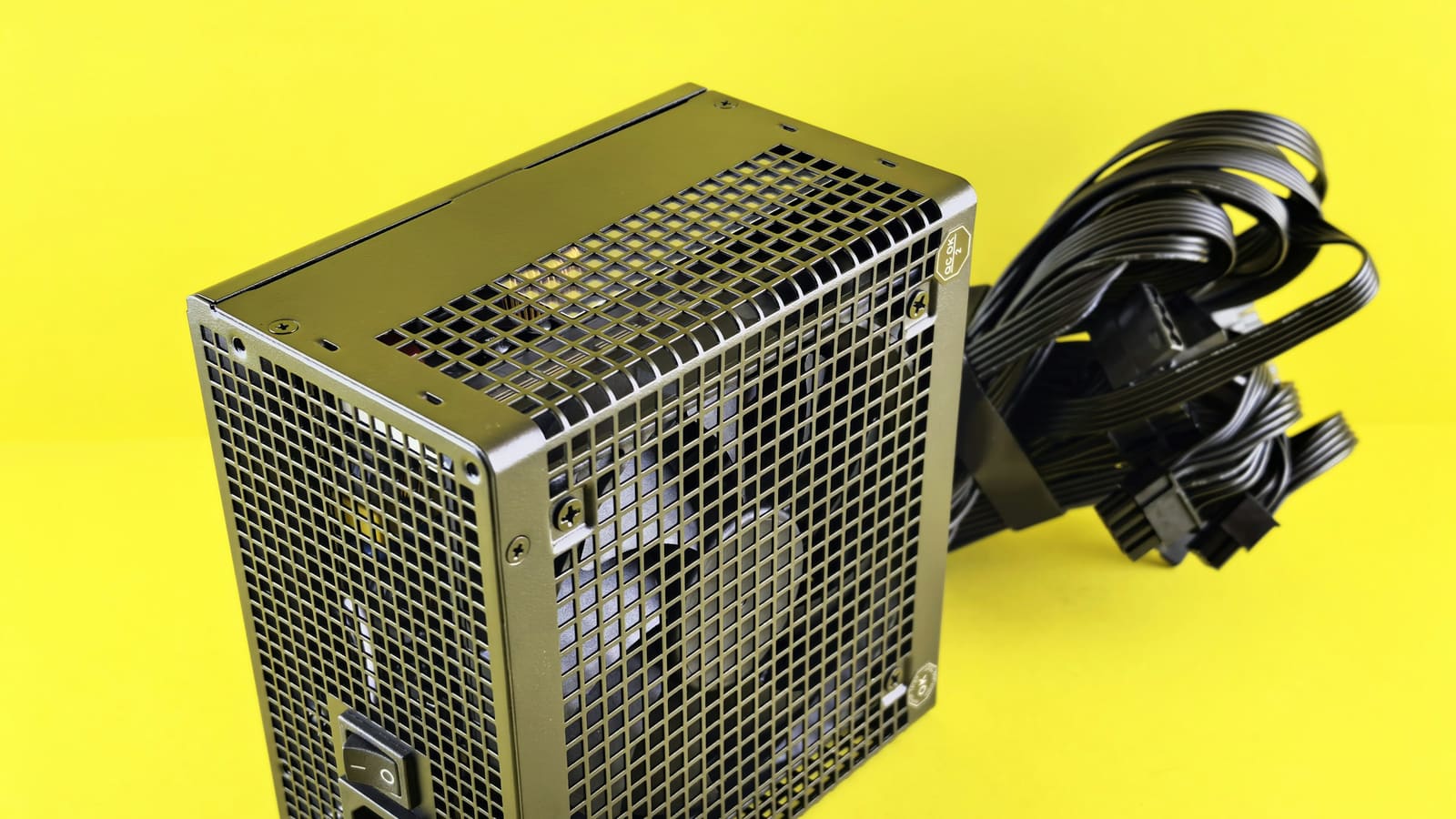
See at Amazon — Corsair RM750e (opens in a new tab)This unit sits in the place most builds actually need: enough capacity for a single mid-range graphics card with room for one upgrade, a warranty far longer than the price suggests, and no attempt to be exciting. The Corsair RM750e (at Amazon, opens in a new tab) earns its place by being unremarkable in exactly the ways that matter.
What it gets right
The warranty. Length is the most useful public signal in this category, because it is the manufacturer stating what it expects to happen. This one is long for the money.
Full modularity at this price. Semi-modular is the norm in this bracket. Being able to leave every unused cable in the box makes a mid-sized build easier and a small one considerably easier.
Silence where it counts. The fan stays stopped through the loads you spend most of your time in. A supply you cannot hear during ordinary use is worth more day to day than one that is marginally quieter at full load.
Where it runs out
The capacity is the boundary. It suits a mid-range or upper-mid card with room to spare and does not suit a flagship, and no amount of good engineering changes that arithmetic. If a top-tier card is anywhere in your plan, this is the wrong unit and a larger one from the same family is the right one.
The cable set is the other limit. It covers a conventional build and leaves little for an unusual one with many drives or a second card. Our full power supply roundup covers the units above and below this one on capacity.
How we assessed this
We have not put this unit on a load tester, measured its ripple, or opened it to identify its platform. This assessment rests on the published specification, the warranty terms, the connector provision and the fit for common builds. It is a judgement about suitability rather than a laboratory result, and the evidence note at the top of this page says exactly that. Our guide to buying a power supply explains the fundamentals this judgement is built on.
Free tool PC Build Compatibility Checker — Will your GPU, PSU, cooler and case actually fit together?Questions people ask
Is this enough for a high-end graphics card?
For a mid-range or upper-mid card, comfortably. For a flagship, no, and that is the clearest limit of this unit rather than a criticism of it. The top of the current graphics range draws enough on its own that pairing it with this capacity would leave the supply working near its ceiling permanently, which is exactly the condition that makes a unit hot, loud and short-lived. If a flagship card is in your plan, even a later one, buy a larger unit now.
Does the fan really stay off?
Under light and moderate load, yes, which covers desktop use, browsing, video and a good deal of ordinary gaming. It spins up under sustained heavy load, as it should, because a supply working hard needs air moving through it. The practical effect is a machine that is silent from the supply for most of the time you are using it, with the fans you can hear being the case fans and the graphics card rather than this.
Is the warranty actually useful?
The length is the point, and it is unusually long for this price. A warranty of this duration on a component priced in the middle of the market tells you what the manufacturer expects its failure rate to be, which is more informative than any specification on the box. It is also a company with a long history of honouring claims on this category, which is the part of a warranty that cannot be read off a datasheet.
Corsair RM750e
The sensible default for a single-card build, and honest about what it is not.