
We have not tested these products. This comparison is reasoned from manufacturer specifications, documentation and warranty terms. How we test
If you buy through a link on this page we may earn a commission. Retailers do not pay for reviews or placement. Prices are shown as bands, never as figures — the live price is at the retailer. As an Amazon Associate I earn from qualifying purchases. How we make money
On this page
The short version
The air cooler that makes most liquid purchases difficult to justify on merit.
See at Amazon — Thermalright Peerless Assassin 120 SE (opens in a new tab)If liquid is the right answer for your build, this is the one that makes sense.
See at Amazon — Arctic Liquid Freezer III 360 (opens in a new tab)The choice is usually framed as performance and is really about clearance, failure modes and how hard the processor is being worked.
Where liquid genuinely wins
Sustained heavy load on a high-power processor. A large radiator has more surface area than any tower and removes heat from the case entirely rather than releasing it inside. For a top-tier part rendering for hours, that is a real advantage, and it is the case a 360mm unit like the Arctic Liquid Freezer III 360 (at Amazon, opens in a new tab) is built for.
Cases with no vertical room. A short case that will not take a tall tower will often take a radiator in the front or top. This is a fit problem with a clear solution.
Clearance around the socket. Removing the tower frees the area above the processor, which matters for tall memory and for access.
Where air wins
Everything else. For a mainstream processor a good dual-tower cooler such as the Thermalright Peerless Assassin 120 SE (at Amazon, opens in a new tab) performs comparably, costs a fraction as much, and has no pump. Our CPU cooler roundup covers both approaches side by side, and the guide to cooling a whole PC walks through matching a cooler to a case.
The failure mode is the argument people underweight. When a fan dies, an air cooler keeps removing heat passively and the machine gets loud and warm. When a pump dies, the loop stops moving and temperatures climb immediately.
How we compared these
This comparison rests on the thermal properties of the two approaches, on published clearance and radiator support figures, and on manufacturer warranty terms as an indication of expected service life. No thermal testing was carried out here.
Free tool PC Build Compatibility Checker — Will your GPU, PSU, cooler and case actually fit together?The picks
 (opens Amazon in a new tab)
 - Band
- $ Budget tier
Thermalright Peerless Assassin 120 SE
The air cooler that makes most liquid purchases difficult to justify on merit.
- Nothing to fail: no pump, no coolant, no tubing
- Costs a fraction of comparable liquid cooling
- Handles mainstream processors without difficulty
- Height requires a clearance check
- Overhangs memory slots on some boards
 (opens Amazon in a new tab)
 - Band
- $$ Mid tier
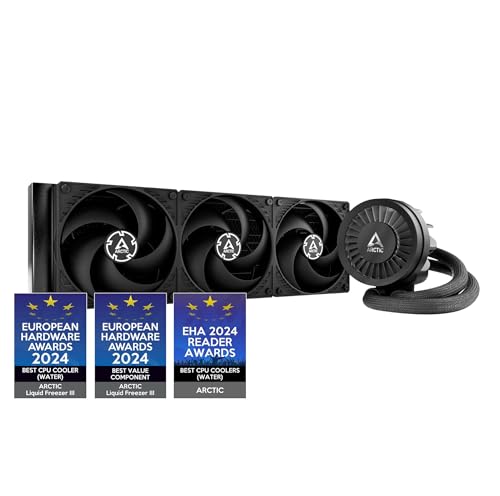
Arctic Liquid Freezer III 360
If liquid is the right answer for your build, this is the one that makes sense.
- Handles the highest-power processors comfortably
- Moves heat out of the case rather than into it
- Leaves the area around the socket clear
- The pump is a wear item with a finite life
- Requires a case that takes a large radiator
Questions people ask
Do liquid coolers leak?
Sealed units very rarely leak, and the failure people should actually plan for is different: the pump stops. A pump is the only moving part in the loop besides the fans, it runs continuously for the life of the machine, and when it fails the cooler stops working almost immediately rather than degrading gracefully. An air cooler with a dead fan still removes heat passively. That difference in failure mode, not leaking, is the honest argument for air.
Is liquid cooling quieter?
Not inherently, and often not in practice. A radiator has more surface area than a tower, so its fans can run slower for the same heat removed, which helps. Against that, the pump adds a noise source that runs constantly and is a different character of sound from a fan, which some people find more intrusive even when it is quieter by measurement. A good tower cooler with a quiet fan is competitive with most liquid coolers on noise and has nothing running when the machine is idle.
How long does a liquid cooler last?
Manufacturers typically warrant them for five or six years, and that figure is a reasonable expectation rather than a guarantee. Coolant permeates slowly through the tubing over time and the pump wears. A well-made tower cooler has no equivalent wear mechanism: its fan is replaceable and its heat pipes will outlast several builds. If you keep machines for a long time or hand them down, that difference in service life is worth weighing.