

We have not tested these products. This comparison is reasoned from manufacturer specifications, documentation and warranty terms. How we test
If you buy through a link on this page we may earn a commission. Retailers do not pay for reviews or placement. Prices are shown as bands, never as figures — the live price is at the retailer. As an Amazon Associate I earn from qualifying purchases. How we make money
On this page
The short version
A 43-inch top that stands, so a small room gets a sit-stand desk without the footprint.
See at Amazon — VIVO Manual Standing Desk 43 x 24 (DESK-KIT-MB4) (opens in a new tab)A motorised desk whose 30-inch depth keeps a monitor at a sensible distance.
See at Amazon — FlexiSpot E7 Pro (opens in a new tab)Assembles in minutes and moves easily, which matters in a shared or rented room.
See at Amazon — Vari Electric Standing Desk (opens in a new tab)Small-desk advice usually optimises the wrong dimension. Width is rarely the binding constraint — you can work at a narrow desk. Depth is, because depth sets how far your eyes are from the screen, and too close is genuinely uncomfortable over a full day.
Depth is the constraint
You want the screen roughly an arm’s length away, and larger panels want more. On a shallow desk with a monitor on its factory stand, you physically cannot achieve that: the stand’s base occupies the rear third of the surface and pushes the panel forward.
The monitor arm is the answer to a small desk
This is the single most effective intervention, and it is worth stating plainly because it does not look like a space-saving product:
- It removes the stand base entirely, recovering the rear of the desk.
- It lets the panel sit back over — or beyond — the rear edge.
- It frees the whole surface underneath.
A 60 cm desk with a monitor arm gives you more usable viewing distance than a 75 cm desk with a stand.
Where the width actually goes
Measure what has to sit on the surface: keyboard, mouse travel, and whatever you genuinely use daily. A full-size keyboard plus comfortable mouse movement needs roughly 80 cm of width. Everything beyond that is storage, and storage is better solved vertically or under the desk than by buying width. If you can spare 48 inches, the FlexiSpot E7 Pro (at Amazon, opens in a new tab), also one of our standing desk picks, is the motorised desk we would fit: it gives up width, not depth.
Going vertical
In a small room the space above the desk is usually empty. A monitor arm, a shelf above the screen line, and under-desk cable management recover more usable area than any change of desk footprint will. The VIVO Manual Standing Desk 43 x 24 (DESK-KIT-MB4) (at Amazon, opens in a new tab) is our pick for the same reason: it is compact, and it stands. In a rented or shared room, where the desk may have to move, the Vari Electric Standing Desk (at Amazon, opens in a new tab) is the one we would choose instead.
The picks
 (opens Amazon in a new tab)
 - Band
- $ Budget tier
VIVO Manual Standing Desk 43 x 24 (DESK-KIT-MB4)
A 43-inch top that stands, so a small room gets a sit-stand desk without the footprint.
- Small footprint for a sit-stand desk
- Standing mode frees floor space visually
- Nothing electronic to fail
- Shallow depth limits monitor distance
- Crank mechanism takes side clearance
 (opens Amazon in a new tab)
 - Band
- $$ Mid tier
FlexiSpot E7 Pro
A motorised desk whose 30-inch depth keeps a monitor at a sensible distance.
- Deep enough for a monitor arm and a keyboard
- Three-stage legs with dual motors
- Three memory presets
- Wider than a true small desk
- Heavier than a simple table
 (opens Amazon in a new tab)
 - Band
- $$$ Upper-mid tier
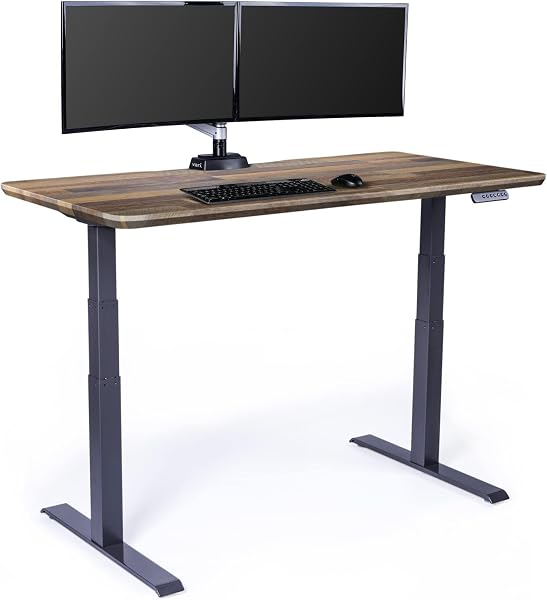
Vari Electric Standing Desk
Assembles in minutes and moves easily, which matters in a shared or rented room.
- Very fast assembly
- Moves without disassembly
- Solid at standing height
- Premium price for the size
- Fewer top options
Questions people ask
How deep does a desk actually need to be?
Deep enough to put your monitor at roughly arm's length, which for most people means about 70 to 80 cm of depth with a monitor sitting on a stand. A monitor arm changes this substantially: because it pushes the screen back over the rear edge and removes the stand's footprint, it can make a 60 cm desk work like a 75 cm one. In a small room, an arm is the single highest-value purchase.
Is a wall-mounted fold-down desk a real option?
For light or occasional use, yes. The limitations are load capacity and the fact that you have to clear the surface to fold it away, which in practice means you do not fold it away. They work well as a secondary or standing-only station and poorly as a primary desk with a monitor permanently on it.
VIVO Manual Standing Desk 43 x 24 (DESK-KIT-MB4)
A 43-inch top that stands, so a small room gets a sit-stand desk without the footprint.