
We have not tested these products. This comparison is reasoned from manufacturer specifications, documentation and warranty terms. How we test
If you buy through a link on this page we may earn a commission. Retailers do not pay for reviews or placement. Prices are shown as bands, never as figures — the live price is at the retailer. As an Amazon Associate I earn from qualifying purchases. How we make money
On this page
The short version
Adjustable lumbar height plus a recline that follows you instead of fighting you.
See at Amazon — Steelcase Series 1 (opens in a new tab)The most adjustable posture support here, with a warranty long enough to matter.
See at Amazon — Herman Miller Aeron (opens in a new tab)Adjustable lumbar and a mesh back at a price that leaves money for a sit-stand desk.
See at Amazon — HON Ignition 2.0 (opens in a new tab)Let us be straightforward about what a chair can and cannot do. A chair does not treat back pain. If you have persistent pain, that belongs with a clinician, not a shopping guide. What a chair can do is stop you spending eight hours in a posture that provokes it.
The mechanism that matters
Sitting without back support rotates the pelvis backwards and flattens the lumbar curve. Held for hours, that loads the spine in a way standing does not. Lumbar support works by holding the pelvis in a more neutral rotation so the curve is maintained without muscular effort.
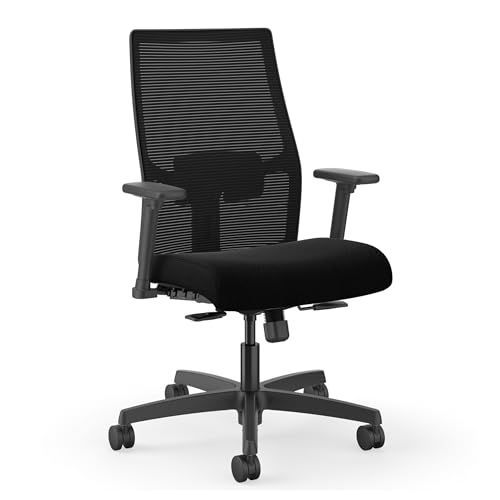
That is why lumbar height adjustment matters more than lumbar depth. Support pressed firmly into the wrong part of your back is not support. Setting lumbar height correctly is the adjustment most people never touch, and the HON Ignition 2.0 (at Amazon, opens in a new tab) is our budget pick because it keeps it.
Movement beats posture
The most useful finding for anyone choosing a chair is that no single posture is sustainable for a full day. Disc pressure, muscle fatigue and circulation all argue for changing position regularly rather than achieving one correct one — the same argument that makes a sit-stand desk worth having.
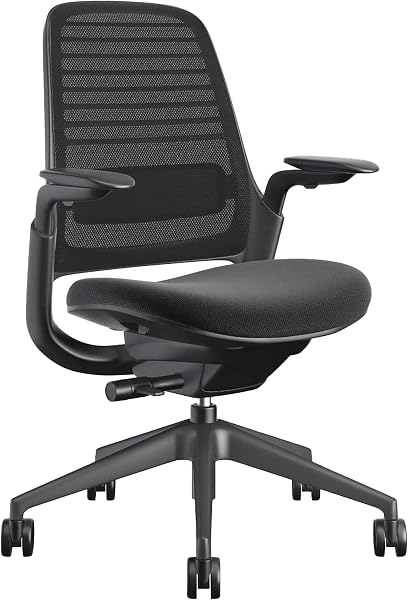
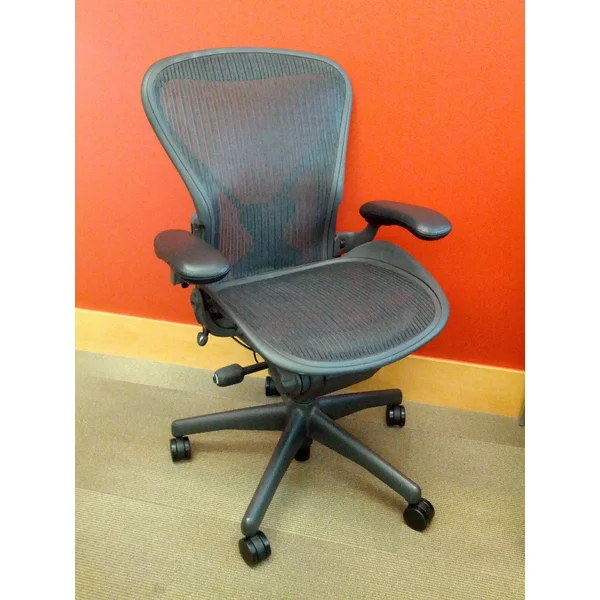
This reframes what to look for. A chair with a recline that moves with you and needs no re-tensioning invites movement. A chair locked rigid upright, however correct its geometry, does not. That is the main reason the Steelcase Series 1 (at Amazon, opens in a new tab) is our pick here; the Herman Miller Aeron (at Amazon, opens in a new tab) is the step up if the chair has to be dialled in precisely.
What to be sceptical of
“Orthopaedic” and “posture-correcting” are marketing terms with no regulatory meaning. Kneeling chairs and saddle stools work well for some people and badly for others, and neither has strong evidence over a conventional adjustable chair. Treat any specific therapeutic claim as unsupported unless the seller can point at the study.
The picks
 (opens Amazon in a new tab)
 - Band
- $$$ Upper-mid tier
Steelcase Series 1
Adjustable lumbar height plus a recline that follows you instead of fighting you.
- Lumbar adjusts in height, not just depth
- Weight-responsive recline
- Flexible back edge allows some twist
- Lumbar travel is moderate
- Headrest is an extra
.jpg)
- Band
- $$$$ Premium tier
Herman Miller Aeron
The most adjustable posture support here, with a warranty long enough to matter.
- Widest adjustment range in this set
- Suspension does not compress
- Three frame sizes
- Highest price here
- Firm mesh seat divides opinion
 (opens Amazon in a new tab)
 - Band
- $$ Mid tier
HON Ignition 2.0
Adjustable lumbar and a mesh back at a price that leaves money for a sit-stand desk.
- Adjustable lumbar at a low price
- Mesh back stays cool
- Durable contract construction
- Utilitarian appearance
- Firm seat foam
Questions people ask
Will a better chair cure my back pain?
No, and any product that claims to should be treated with suspicion. Persistent back pain is a medical matter and belongs with a clinician. What a chair can do is remove a mechanical provocation: it can stop you sitting in a slumped posture for eight hours because the chair gives you nothing to sit against. That is worth a great deal, but it is prevention of aggravation, not treatment.
Is a lumbar cushion as good as a chair with built-in support?
A cushion can work well, and it is far cheaper. Its weakness is that it moves. Every time you stand up and sit down it shifts, and a lumbar support in the wrong place is doing nothing. Built-in support stays where you set it. If you are testing whether more lumbar support helps you at all, a cushion is a sensible cheap experiment first.
Should I be reclining or sitting upright?
Reclining slightly, around 100 to 110 degrees, measurably reduces disc pressure compared with sitting bolt upright, provided the backrest actually supports you through the recline. The bigger point is that no single posture is good for eight hours. A chair that makes it easy to change position is doing more for you than one that holds you in a theoretically perfect one.
Steelcase Series 1
Adjustable lumbar height plus a recline that follows you instead of fighting you.