
We have not tested these products. This comparison is reasoned from manufacturer specifications, documentation and warranty terms. How we test
If you buy through a link on this page we may earn a commission. Retailers do not pay for reviews or placement. Prices are shown as bands, never as figures — the live price is at the retailer. As an Amazon Associate I earn from qualifying purchases. How we make money
On this page
The short version
A wide asymmetric throw designed to light the desk without hitting the screen.
See at Amazon — BenQ e-Reading Lamp (opens in a new tab)A clamp-on metal task lamp that points where you put it, for very little money.
See at Amazon — Globe Electric 56963 Multi-Joint Desk Lamp (opens in a new tab)Enormous adjustment range and colour control, at a price that needs justifying.
See at Amazon — Dyson Solarcycle Morph (opens in a new tab)A desk lamp for screen work is doing a different job from a reading lamp, and buying the wrong kind produces glare rather than comfort.
The job is raising the surround, not lighting the page
When you read on paper, the lamp lights the paper. When you work on a screen, the screen lights itself — what the lamp needs to do is raise the brightness of everything around the screen so your eyes are not working against a bright rectangle in a dark room. The full guide to desk lighting covers the other two layers, ambient and bias.
That reframes what a good lamp looks like: wide and diffuse rather than narrow and bright — and it is why a light bar is often the better tool if no paper ever crosses the desk. Our ScreenBar review looks at what a premium bar adds over the cheaper ones.
Glare is the failure mode
A conventional lamp aimed at the desk will also put light on the screen, which washes out contrast and is worse than no lamp at all.
Three ways to avoid it:
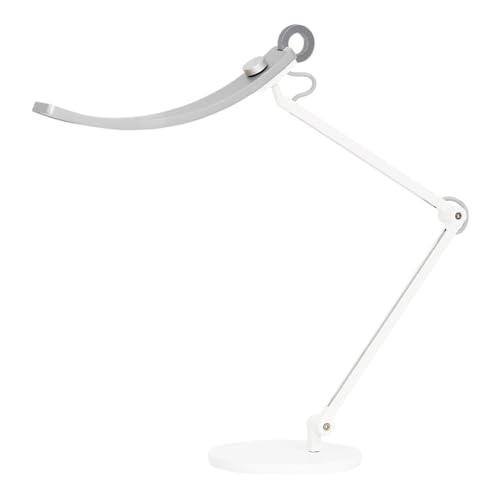
- Asymmetric optics, which throw light forward onto the desk and not upward onto the screen. This is what purpose-built screen-work lamps such as the BenQ e-Reading Lamp (at Amazon, opens in a new tab) do, and it is the same principle monitor light bars are built on.
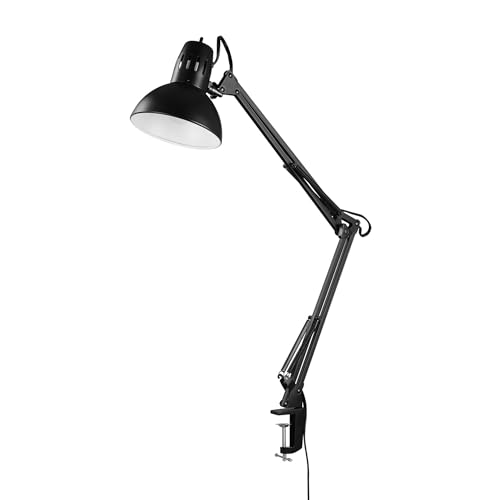
- Position it beside and slightly behind the screen plane, pointing away. A simple directional lamp like the Globe Electric 56963 Multi-Joint Desk Lamp (at Amazon, opens in a new tab) works this way.
- Bounce it off a wall or ceiling, trading efficiency for a very even result.
Wherever it sits, the lamp’s cable goes back to the power strip with everything else. Mounting that strip under the desk keeps the run short, and trays and clips for the rest of the cables finish the job.
Colour temperature
4000K to 5000K in the daytime — neutral white. Warmer than that starts to look dingy against a screen’s white point; cooler starts to feel clinical.
In the evening, warmer is defensible for sleep reasons rather than eye-comfort ones. A lamp with adjustable colour temperature — the Dyson Solarcycle Morph (at Amazon, opens in a new tab) is the fullest version of that — lets you make the shift without a second fixture.
What not to spend money on
Anything sold specifically as a “blue light reducing” lamp. The evidence that blue light causes eye strain is weak, and a lamp marketed on that basis is usually just a warm lamp with a premium attached.
The picks
 (opens Amazon in a new tab)
 - Band
- $$$$ Premium tier
BenQ e-Reading Lamp
A wide asymmetric throw designed to light the desk without hitting the screen.
- Asymmetric optics keep light off the screen
- Very wide coverage
- Adjustable colour temperature
- Expensive
- Utilitarian appearance
 (opens Amazon in a new tab)
 - Band
- $ Budget tier
Globe Electric 56963 Multi-Joint Desk Lamp
A clamp-on metal task lamp that points where you put it, for very little money.
- Very inexpensive
- Clamps to the desk edge, off the surface
- Multi-joint arm directs light precisely
- No dimming, just an on/off switch
- Bulb sold separately
 (opens Amazon in a new tab)
 - Band
- $$$$ Premium tier
Dyson Solarcycle Morph
Enormous adjustment range and colour control, at a price that needs justifying.
- Huge positional range
- Precise colour temperature control
- Excellent build
- Very expensive
- Overkill for ordinary screen work
Questions people ask
What colour temperature should a desk lamp be?
Around 4000K to 5000K for daytime work — neutral white, neither the yellow of a living room nor the blue of an operating theatre. In the evening, shifting warmer, towards 2700K to 3000K, is sensible if the light is on late, because bright cool light in the evening does have reasonable evidence for affecting sleep timing.
How much light do I need at a desk?
Office standards generally target 300 to 500 lux at the desk surface for general work. That is more than most home offices actually have, particularly in winter. The point is not brightness for its own sake but reducing the contrast between a bright screen and a dim surround, which is what makes eyes tire.
BenQ e-Reading Lamp
A wide asymmetric throw designed to light the desk without hitting the screen.