
We have not tested these products. This comparison is reasoned from manufacturer specifications, documentation and warranty terms. How we test
If you buy through a link on this page we may earn a commission. Retailers do not pay for reviews or placement. Prices are shown as bands, never as figures — the live price is at the retailer. As an Amazon Associate I earn from qualifying purchases. How we make money
On this page
The short version
Sidesteps the argument: a dynamic capsule with both outputs on the same body.
See at Amazon — Shure MV7+ (opens in a new tab)The analogue-only answer, and priced so the interface is still affordable afterwards.
See at Amazon — Rode PodMic (opens in a new tab)The question is usually framed as sound quality and is really about how many things you want on your desk and what you expect to change.
What USB actually is
A microphone with a preamplifier and an analogue-to-digital converter built into the same body. One cable, no configuration, appears in software immediately.
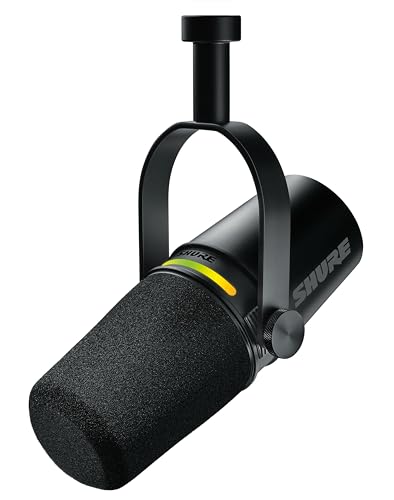
The cost is that the chain is sealed. If the preamplifier is noisy, that is the microphone’s noise floor forever. The Shure MV7+ (at Amazon, opens in a new tab) is worth knowing here, since it puts both outputs on the same body.
What the analogue route actually is
The same three components in two or three separate boxes. More cost, more desk space, more cables.
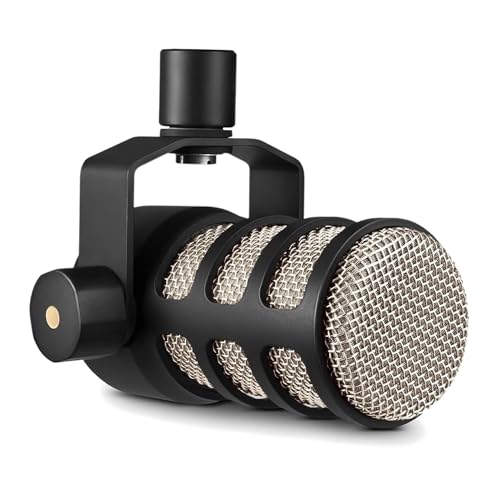
What you buy is independence. A better interface later without a new microphone. Two microphones on separate tracks. The same microphone through three computers. The Rode PodMic (at Amazon, opens in a new tab) is a straightforward example: dynamic capsule, XLR only, priced to leave room for an interface.
Choosing
One person, one voice, simplicity valued: USB. Two people, or an expectation of changing something later: analogue. Uncertain: a microphone with both outputs, which defers the decision at a modest premium. See our USB microphones roundup or XLR microphones roundup for specific picks.
How we compared these
This comparison rests on the signal chain each route implies and on published specifications for the microphones named. Nothing was recorded or measured for it.
The picks
 (opens Amazon in a new tab)
 - Band
- $$$ Upper-mid tier
Shure MV7+
Sidesteps the argument: a dynamic capsule with both outputs on the same body.
- USB today, analogue whenever you want it
- Dynamic capsule suits an untreated room
- Useful onboard processing over USB
- Costs more than a comparable single-output microphone
- Analogue side still needs an interface eventually
 (opens Amazon in a new tab)
 - Band
- $$ Mid tier
Rode PodMic
The analogue-only answer, and priced so the interface is still affordable afterwards.
- Runs on ordinary interface gain, no booster needed
- Built to a standard the price does not suggest
- Internal pop filter handles plosives
- Needs an interface before it does anything
- Heavy enough to demand a proper arm
Questions people ask
Does the analogue route sound better?
Not inherently, and the difference is smaller than the price gap suggests. A good USB microphone contains a competent preamplifier and converter, and at ordinary speaking levels in an ordinary room you would struggle to identify which route a recording came from. What the analogue route gives you is not a better sound today but a chain where any single component can be improved later, and the ability to record two sources onto separate tracks.
Can I use both at once?
On a computer, this needs care. Operating systems generally expect one audio input device at a time, and combining a USB microphone with an interface means either software that can aggregate devices or accepting that you choose one. If you genuinely need two sources, the clean answer is one interface with two inputs, which records both onto separate tracks and keeps them in sync. Mixing two USB devices is where most audio drift problems come from.
Which is better for streaming specifically?
USB for most people, because streaming rewards simplicity and a single device that appears in the software with no configuration. The analogue route becomes worth the complexity when you have a co-host in the room, when you want to route game audio and voice separately, or when you already own an interface for something else. If you are one person talking to a camera, the extra box adds cost and cabling for a difference nobody watching will notice.