
We have not tested these products. This comparison is reasoned from manufacturer specifications, documentation and warranty terms. How we test
If you buy through a link on this page we may earn a commission. Retailers do not pay for reviews or placement. Prices are shown as bands, never as figures — the live price is at the retailer. As an Amazon Associate I earn from qualifying purchases. How we make money
On this page
The verdict
Deserves its reputation, and needs a preamplifier that most first-time buyers do not own.
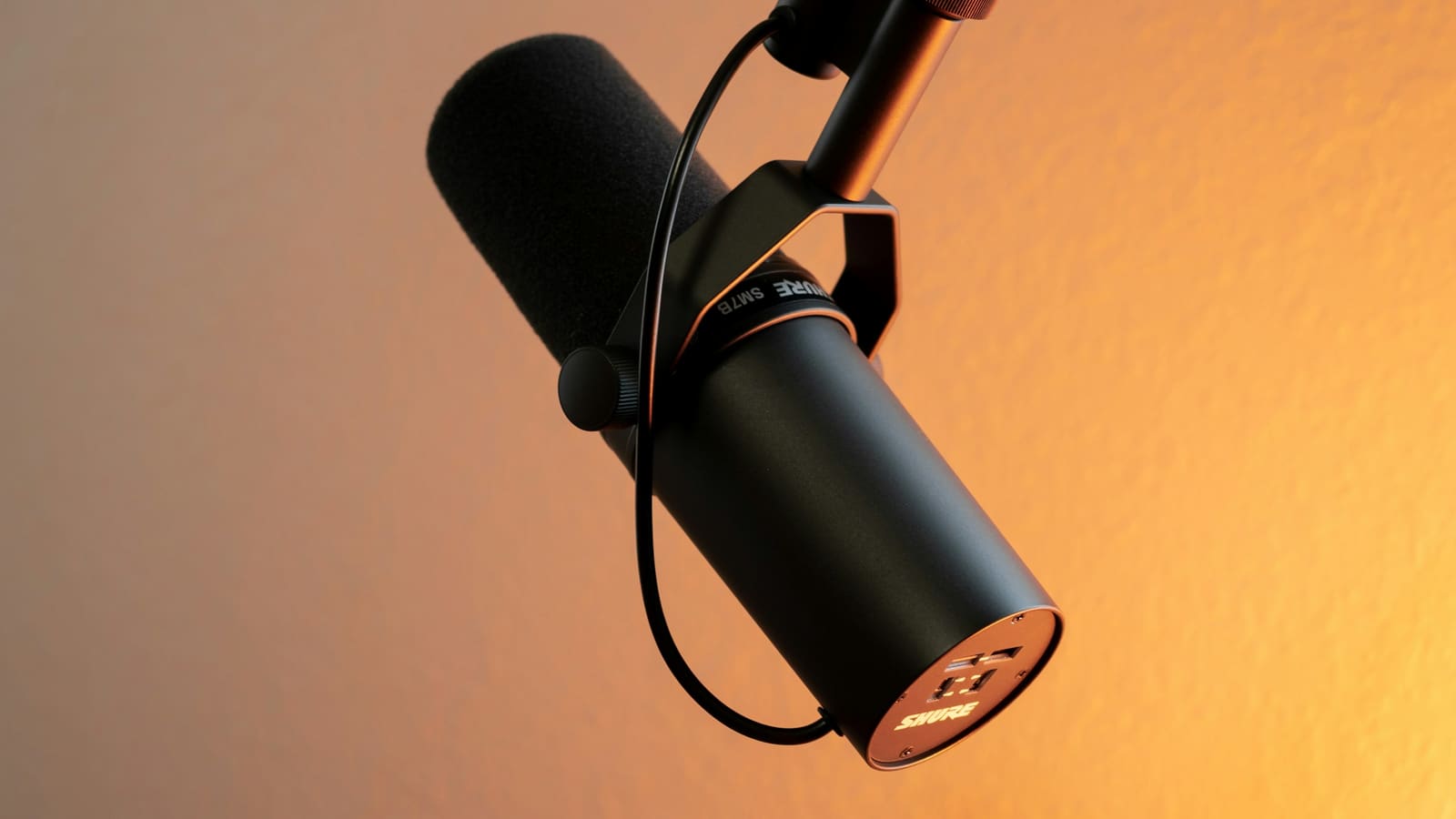
See at Amazon — Shure SM7B (opens in a new tab)This microphone has a reputation that precedes it and a requirement that follows it. Both are real.
Why it earned the reputation
Rejection. The Shure SM7B (at Amazon, opens in a new tab) hears what is directly in front of it and is remarkably uninterested in everything else. In an untreated room with hard surfaces, that single characteristic does more for a recording than any processing.
Everything is built in. The shock mount is internal, so desk and arm knocks do not travel through. The pop filtering is internal too. There is nothing to buy and nothing to fit.
It will outlast you. These turn up second-hand from the eighties and still work.
What it is not
It is not a detailed microphone. It is voiced to be smooth and forgiving, which is exactly what you want for a voice recorded daily and not what you want if you are after the airy top end a good condenser gives in a treated room.
It is also not a cheap way to sound professional. The microphone, the booster and a stand capable of holding it add up to considerably more than a good USB setup. Our XLR microphones roundup covers cheaper alternatives, and our USB vs XLR comparison explains that tradeoff in general.
How we assessed this
We have not recorded with this microphone or measured it. This assessment rests on the published output level and polar pattern, on the documented internal mounting and filtering, and on its gain requirements against common interfaces. It is a judgement about suitability rather than a listening test, and the evidence note at the top of the page states that.
Questions people ask
Do I need a gain booster for it?
With most ordinary interfaces, yes. This microphone has unusually low output, and a typical interface turned to maximum will deliver enough level while also delivering its own hiss along with your voice. The two clean solutions are an inline gain booster between microphone and interface, or an interface whose preamplifiers were designed with this kind of load in mind. Budget for whichever you choose at the same time as the microphone rather than discovering it afterwards.
Why does it sound dull compared to my old microphone?
Because it is doing its job. It is deliberately voiced to reduce sibilance and harshness, and it rejects the high-frequency room reflections that a condenser captures as air and detail. Compared side by side in a quiet room a condenser will sound more open. In a normal room the condenser also sounds like the room, and this does not. There is a presence switch on the back that lifts the upper range if you want more of that character.
Is it worth it over cheaper dynamics?
For rejection and for build, it is genuinely a step up, and for a voice you record every day the difference accumulates. But cheaper broadcast dynamics get most of the way there at a fraction of the price and without the gain problem, and the money saved buys an arm and some room treatment that would improve the result more. Buy this if you record daily and want to stop thinking about it. Buy less if you are still finding out.
Shure SM7B
Deserves its reputation, and needs a preamplifier that most first-time buyers do not own.