
We have not tested these products. This comparison is reasoned from manufacturer specifications, documentation and warranty terms. How we test
If you buy through a link on this page we may earn a commission. Retailers do not pay for reviews or placement. Prices are shown as bands, never as figures — the live price is at the retailer. As an Amazon Associate I earn from qualifying purchases. How we make money
On this page
Four decisions, and the first one is made by your room rather than by you.
1. Dynamic or condenser
Dynamic. Less sensitive, needs you close, largely ignores the room. The right answer for an untreated space, which is most spaces, and the reason our USB microphone pick is a dynamic.
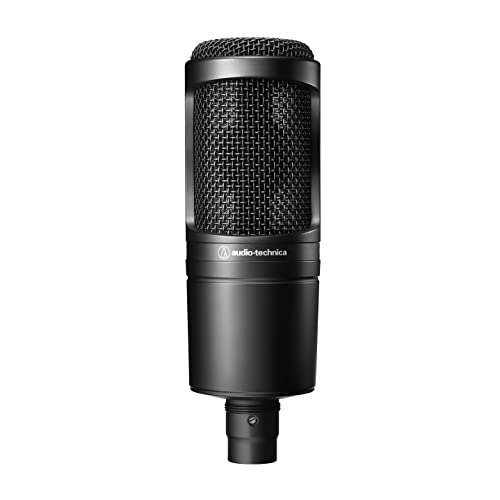
Condenser. More sensitive, more detailed, reproduces everything including the room. The right answer in a quiet, soft-furnished space. The Audio-Technica AT2020 (at Amazon, opens in a new tab) is a common way into that category once your room qualifies.
Be honest about the room. A condenser in a reflective room is the most common disappointment in home audio. If the budget is the binding constraint rather than the room, the budget microphones we recommend are dynamics for that reason.
2. Polar pattern
Cardioid for one person at a desk. Omnidirectional if you genuinely want the room. Figure-of-eight for two people facing each other. For most readers this is not a decision, it is a default.
3. Connection
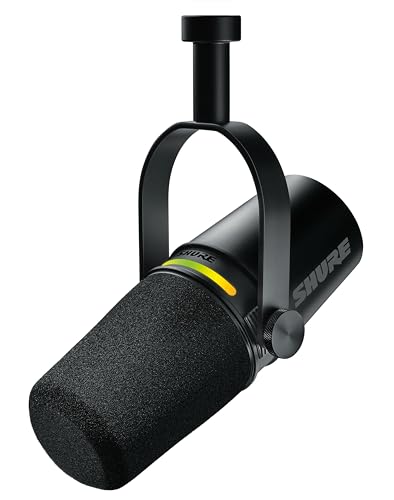
USB puts the whole chain in one body: simple, fixed. Analogue separates the links: more boxes, upgradeable one at a time, and it allows two people on separate tracks. Our USB vs XLR microphones comparison goes through the tradeoff in more depth. The Shure MV7+ (at Amazon, opens in a new tab) sidesteps the choice entirely by putting both outputs on one body.
4. Mounting
An arm, not the bundled desk stand. The stand transmits every keystroke into the capsule and holds the microphone at the wrong height. This is not an accessory decision, it is part of the purchase. See how to set up a microphone for the rest of the checklist.
How we assessed these
This guide rests on published capsule types, polar patterns, output levels and connectivity, and on the acoustics of ordinary rooms. Nothing here was recorded or measured by us, and the evidence note at the top of the page says so.
What we recommend
 (opens Amazon in a new tab)
 - Band
- $$$ Upper-mid tier
Shure MV7+
A dynamic capsule with both connection types, which suits most rooms and most plans.
- Dynamic capsule handles an untreated room
- USB and analogue outputs on one body
- Onboard processing that is genuinely useful
- Costs well above entry microphones
- Wants to be close to your mouth
 (opens Amazon in a new tab)
 - Band
- $ Budget tier
Audio-Technica AT2020
The entry condenser to buy if your room has earned one.
- Detailed capture at a low price
- Standard connection works with any interface
- Easy to mount on anything
- Reproduces the room along with your voice
- Needs an interface with phantom power
Questions people ask
What does the polar pattern tell me?
Which directions the microphone listens in. Cardioid, the most common, listens forward and rejects what is behind it, which is what you want for one person speaking towards a wall. Omnidirectional listens equally in all directions and is right for capturing a room or a group deliberately. Figure-of-eight listens front and back and rejects the sides, which suits two people facing each other. For a single voice at a desk, cardioid is almost always the answer.
Does an expensive microphone make me sound better?
Less than position, room and gain structure do. A microphone changes tonal character, and character is a preference rather than a quality ranking, so a more expensive capsule sounds different rather than uniformly better. What consistently separates good home audio from bad is being close enough, sitting in a room that is not reflective, and setting levels so the signal is well above the noise floor without clipping. Those three are mostly free.
What is proximity effect?
The rise in low frequencies you get as you move closer to a directional microphone. It is why broadcast voices sound warm and full, and it is a tool rather than a fault: move closer for more weight, back off if it becomes boomy. It is also why a microphone can sound thin at a distance and rich up close, which catches people who set their tone at one distance and then record at another. Omnidirectional microphones do not exhibit it.