
We have not tested these products. This comparison is reasoned from manufacturer specifications, documentation and warranty terms. How we test
If you buy through a link on this page we may earn a commission. Retailers do not pay for reviews or placement. Prices are shown as bands, never as figures — the live price is at the retailer. As an Amazon Associate I earn from qualifying purchases. How we make money
On this page
The short version
The broadcast standard, and the reason so many home setups sound like a radio studio.
See at Amazon — Shure SM7B (opens in a new tab)Most of what a broadcast dynamic gives you, at a gain requirement normal interfaces meet.
See at Amazon — Rode PodMic (opens in a new tab)The condenser people start with, and it deserves the position if your room is quiet.
See at Amazon — Audio-Technica AT2020 (opens in a new tab)The analogue route means a microphone, a cable and an interface instead of one object. What you buy for the extra cost and desk space is a chain where every link is replaceable.
Gain is the specification people miss
Microphones differ enormously in how much signal they produce, and the broadcast dynamics that everyone wants produce very little. Paired with an interface that cannot supply enough clean gain, you end up turning everything to maximum and recording hiss along with your voice.
This is the single most common expensive mistake in this category, because neither product is faulty. They are simply not a pair. The Shure SM7B (at Amazon, opens in a new tab) is the best-known example, and the SM7B review is mostly about that requirement.
Dynamic or condenser, again
The same decision as the USB category and the same answer: your room decides. Untreated room with hard surfaces, buy a dynamic. Quiet room with carpet and curtains, a condenser will reward you, and the Audio-Technica AT2020 (at Amazon, opens in a new tab) is the one to start with, provided your interface supplies phantom power.
The difference is that here you can change your mind later without replacing the whole chain.
How we chose
Nothing here was recorded or measured by us. This guide rests on published output levels and polar patterns, on gain requirements against common interfaces, and on build and mounting characteristics. The evidence note at the top of the page says so plainly.
The picks
 (opens Amazon in a new tab)
 - Band
- $$$$ Premium tier
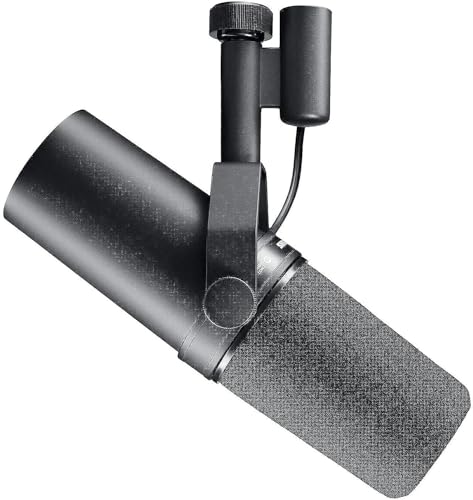
Shure SM7B
The broadcast standard, and the reason so many home setups sound like a radio studio.
- Rejects room and handling noise exceptionally well
- Internal shock mount and pop filter included
- Effectively indestructible and holds resale value
- Needs far more gain than most interfaces provide alone
- Costs more than a whole USB setup
 (opens Amazon in a new tab)
 - Band
- $$ Mid tier
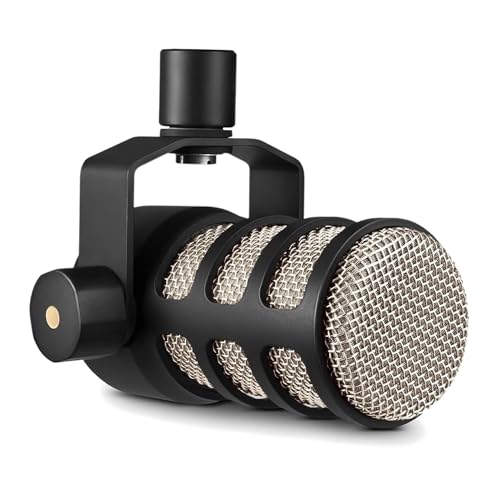
Rode PodMic
Most of what a broadcast dynamic gives you, at a gain requirement normal interfaces meet.
- Works with ordinary interface gain
- Internal pop filter handles plosives well
- Built like something that will outlast you
- Heavy enough to need a serious boom arm
- Less detailed than the premium option
 (opens Amazon in a new tab)
 - Band
- $ Budget tier
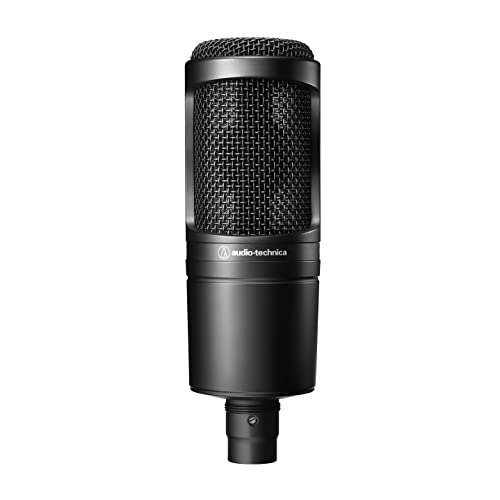
Audio-Technica AT2020
The condenser people start with, and it deserves the position if your room is quiet.
- Detailed capture at an entry price
- Works with any interface that supplies phantom power
- Light enough for any stand or arm
- Captures the entire room, not just you
- Needs phantom power, unlike the dynamics here
Questions people ask
What is phantom power and do I need it?
It is a supply voltage that interfaces send up the cable to power a condenser microphone, which needs electricity to work at all. Dynamic microphones do not need it and are not harmed by it on any modern interface, so leaving it switched on is not the hazard it is sometimes described as. What matters practically is that if you buy a condenser, your interface must be able to supply it, and essentially every interface sold today can.
Why does my microphone sound quiet even at full gain?
Some broadcast dynamic microphones have unusually low output and need substantially more gain than a typical interface provides on its own. Turned up to maximum, the interface delivers the level but also delivers its own noise floor, so you get a quiet signal with audible hiss behind it. The fix is either an inline gain booster between microphone and interface, or an interface with genuinely high-gain preamplifiers. Check the requirement before buying the microphone.
Is the analogue route worth the extra cost?
It is if you expect to change something later, because the point is that each piece is separate. You can improve the interface without replacing the microphone, use two microphones on separate tracks, or keep a microphone through three computers. If you want one thing on the desk that works today and you have no plans beyond that, a USB microphone gives you most of the sound quality with none of the extra boxes.
Shure SM7B
The broadcast standard, and the reason so many home setups sound like a radio studio.