
We have not tested these products. This comparison is reasoned from manufacturer specifications, documentation and warranty terms. How we test
If you buy through a link on this page we may earn a commission. Retailers do not pay for reviews or placement. Prices are shown as bands, never as figures — the live price is at the retailer. As an Amazon Associate I earn from qualifying purchases. How we make money
On this page
The short version
A dynamic capsule with a USB output, which is the combination an untreated room needs.
See at Amazon — Shure MV7+ (opens in a new tab)The detailed, open sound people expect from a studio microphone, if the room allows it.
See at Amazon — Rode NT-USB+ (opens in a new tab)Built around the software rather than the capsule, and the software is the reason to buy it.
See at Amazon — Elgato Wave:3 (opens in a new tab)A dynamic microphone with both outputs at a price that makes the argument for itself.
See at Amazon — Samson Q2U (opens in a new tab)A USB microphone is a microphone, a preamplifier and an audio interface in one body. That removes several decisions and one important freedom, and for most people it is the right trade.
The decision that matters more than the model
Dynamic or condenser, and it is decided by your room rather than your budget. Our microphone buying guide covers that choice alongside polar pattern, connection and mounting.
A condenser is more sensitive and more detailed. In a quiet room with soft furnishings it sounds better. In a room with bare walls, a hard desk and a window onto a street, it faithfully captures all of that.
A dynamic capsule is less sensitive and needs you closer. What you get for that is a microphone that largely ignores the room. Most people recording at a desk at home are better served by a dynamic, and most people buy a condenser.
That is why the Shure MV7+ (at Amazon, opens in a new tab) is our pick and the Samson Q2U (at Amazon, opens in a new tab) the budget one. The Rode NT-USB+ (at Amazon, opens in a new tab) is the condenser for a room that can carry it. For a smaller spend, the budget microphone picks follow the same room-first reasoning.
What you give up
The signal chain. A USB microphone’s preamplifier and converter are what they are, and you cannot replace one part without replacing all of it. You also cannot easily record two people on separate tracks.
If either of those matters, the analogue route with a separate interface is the one to look at. The XLR microphone picks start there, and our Shure SM7B review covers the best-known broadcast dynamic on that route.
How we chose
We have not recorded with these microphones or measured them. This guide rests on published polar patterns and capsule types, on connectivity, and on how each design behaves in the untreated rooms most people actually record in. The evidence note at the top of this page states that plainly.
The picks
 (opens Amazon in a new tab)
 - Band
- $$$ Upper-mid tier
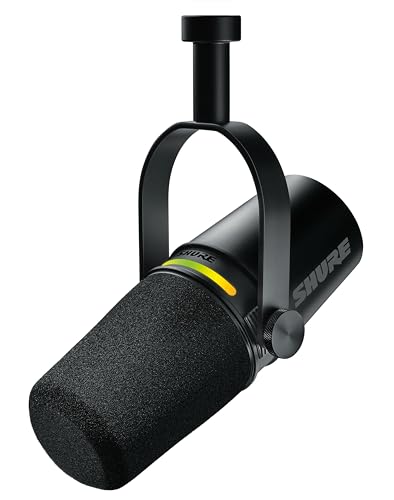
Shure MV7+
A dynamic capsule with a USB output, which is the combination an untreated room needs.
- Dynamic capsule rejects room reflections well
- Works over USB now and over the analogue output later
- Onboard processing is genuinely useful rather than gimmick
- Needs to be close to your mouth to sound its best
- Costs considerably more than entry USB microphones
 (opens Amazon in a new tab)
 - Band
- $$ Mid tier
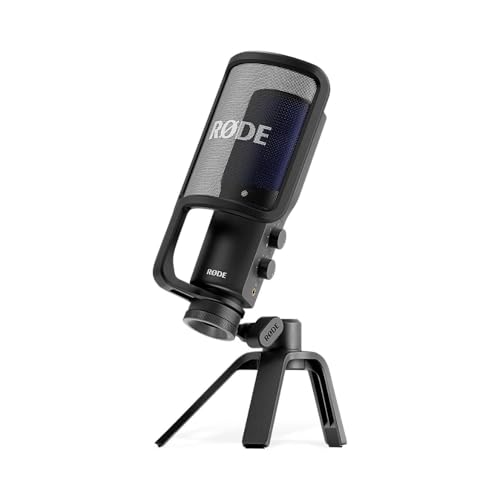
Rode NT-USB+
The detailed, open sound people expect from a studio microphone, if the room allows it.
- Clear, detailed capture with genuine presence
- Well-implemented headphone monitoring built in
- Solid metal construction that will outlast the computer
- Condenser capsule picks up the whole room
- Sensitive to keyboard and desk noise

- Band
- $$ Mid tier
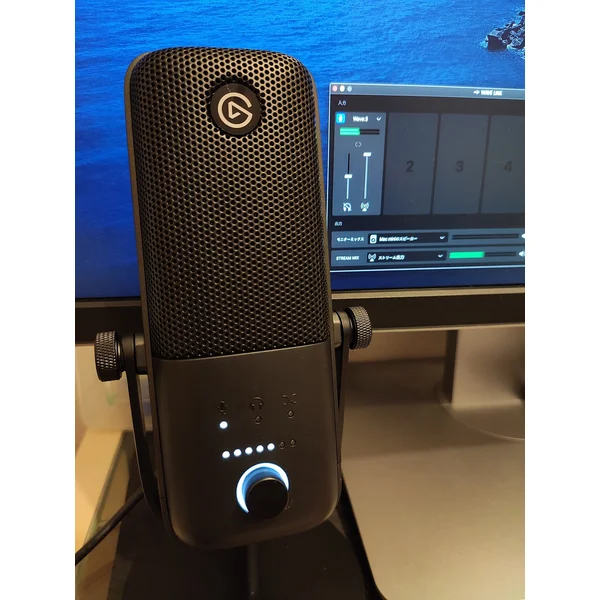
Elgato Wave:3
Built around the software rather than the capsule, and the software is the reason to buy it.
- Mixing software handles multiple sources cleanly
- Clipping protection that actually works
- Compact enough for a crowded desk
- Condenser capsule needs a controlled room
- The software is Windows-first
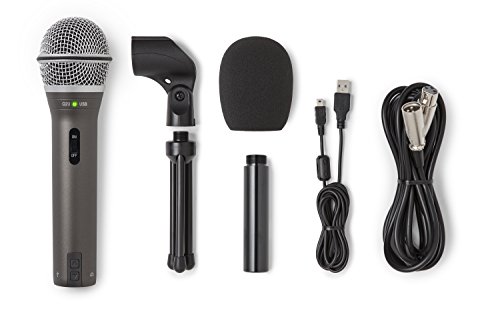 (opens Amazon in a new tab)
 - Band
- $ Budget tier
Samson Q2U
A dynamic microphone with both outputs at a price that makes the argument for itself.
- Dynamic capsule copes with a poor room
- USB and analogue outputs on the same body
- Costs a fraction of everything else here
- Plain sound with no onboard processing
- Included stand is not worth using
Questions people ask
Why does my USB microphone pick up so much room noise?
Almost certainly because it is a condenser and you are too far from it. Condenser capsules are sensitive by design, and sensitivity is not selective: it captures your voice and the room and the desk fan with equal enthusiasm. Two changes fix most of it. Get closer, ideally within a hand span, which raises your voice relative to everything else. And if the room is genuinely reflective, a dynamic microphone will serve you far better than any amount of software processing.
Do I need a boom arm?
It is the accessory that changes recordings most, and it is more important than upgrading the microphone for most people. A desk stand transmits every keystroke and knock straight up into the capsule, and it puts the microphone at desk height where you are speaking across it rather than into it. A boom arm gets the microphone close to your mouth at the right angle and isolates it from the desk, which addresses two of the three most common complaints at once.
Can I use a USB microphone with a console?
Often, but check before assuming. Many consoles accept a class-compliant USB audio device for chat, and many microphones are class-compliant, but the combination is not guaranteed and some microphones need their own software to behave properly. Where support exists it is frequently limited to chat rather than being available to every application. If console use is the main reason for the purchase, verify that specific microphone with that specific console rather than trusting the category.
Shure MV7+
A dynamic capsule with a USB output, which is the combination an untreated room needs.