

We have not tested these products. This comparison is reasoned from manufacturer specifications, documentation and warranty terms. How we test
If you buy through a link on this page we may earn a commission. Retailers do not pay for reviews or placement. Prices are shown as bands, never as figures — the live price is at the retailer. As an Amazon Associate I earn from qualifying purchases. How we make money
On this page
The short version
Closed, comfortable for hours, and built so the parts you wear out can be replaced.
See at Amazon — Beyerdynamic DT 770 Pro (opens in a new tab)The closed pair that gets closest to a neutral response without punishing your ears.
See at Amazon — AKG K371 (opens in a new tab)The durable default. Not neutral, but consistent, and it survives being thrown in a bag.
See at Amazon — Audio-Technica ATH-M50x (opens in a new tab)The studio workhorse that has outlived several formats, and still costs very little.
See at Amazon — Sony MDR-7506 (opens in a new tab)Headphones for streaming have one hard requirement and one that matters more than people expect.
The hard requirement: closed backs
Open-back headphones leak sound outwards. With a microphone a hand span from your face, that leak ends up in your recording, and it cannot be removed afterwards. Speakers are out while a microphone is live for the same reason; desk studio monitors belong to editing and mixing afterwards.
If you record with anything playing — game audio, a co-host, music — closed backs are not a preference, and our closed-back headphone roundup goes further into what sealing costs.
The one that matters more than expected: comfort
You will wear these for hours at a time, and hearing yourself while you record means wearing them through every session. Clamping force, pad material and weight decide whether that is pleasant or something you keep taking off.
Velour pads are cooler and softer; synthetic leather isolates better and gets warm. Neither is correct, but the choice will affect your sessions more than a small difference in frequency response.
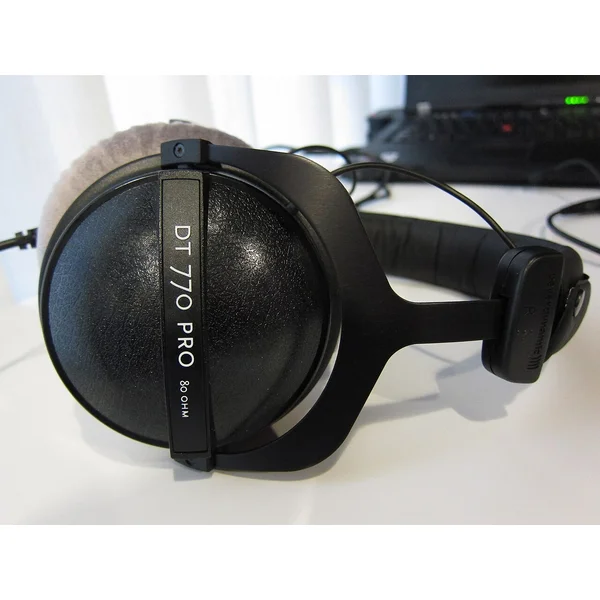
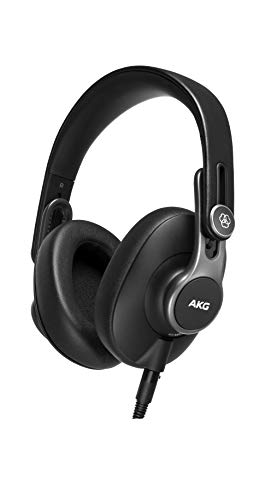
The Beyerdynamic DT 770 Pro (at Amazon, opens in a new tab) is our pick largely on comfort, and the full DT 770 Pro review covers the ordering trap. The AKG K371 (at Amazon, opens in a new tab) is the one to choose if an even response matters more to you.
Replaceable parts
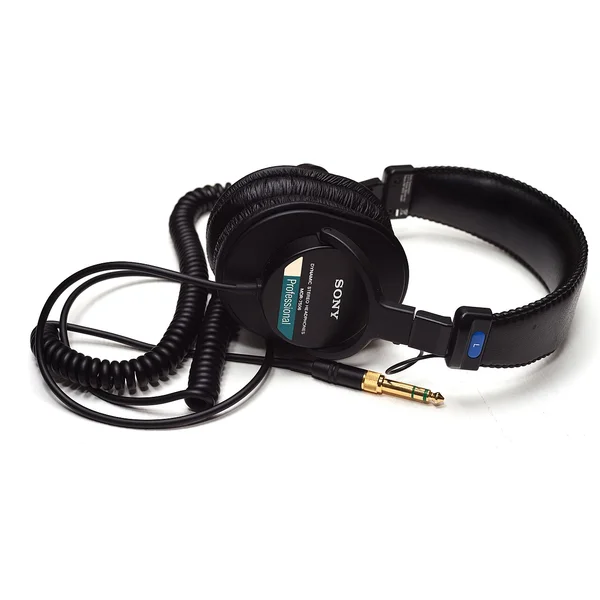
Pads compress and cables fail. Headphones whose parts are available as spares last a decade; headphones whose parts are not become disposable the first time something goes. It is why the Sony MDR-7506 (at Amazon, opens in a new tab) is still in studios decades on.
How we chose
We have not listened to these on a controlled system or measured them. This guide rests on published impedance and driver specifications, on enclosure type, on pad materials and on parts availability. The evidence note at the top of the page states the basis.
The picks

- Band
- $$ Mid tier
Beyerdynamic DT 770 Pro
Closed, comfortable for hours, and built so the parts you wear out can be replaced.
- Velour pads stay comfortable over long sessions
- Every wearing part is available as a spare
- Strong isolation stops speaker bleed into the microphone
- Lifted treble is fatiguing for some listeners
- Fixed cable rather than detachable
 (opens Amazon in a new tab)
 - Band
- $$ Mid tier
AKG K371
The closed pair that gets closest to a neutral response without punishing your ears.
- Notably even response for a closed design
- Folds flat and travels well
- Detachable cable in three lengths
- Pads compress faster than the alternatives
- Isolation is good rather than exceptional
 (opens Amazon in a new tab)
 - Band
- $$ Mid tier
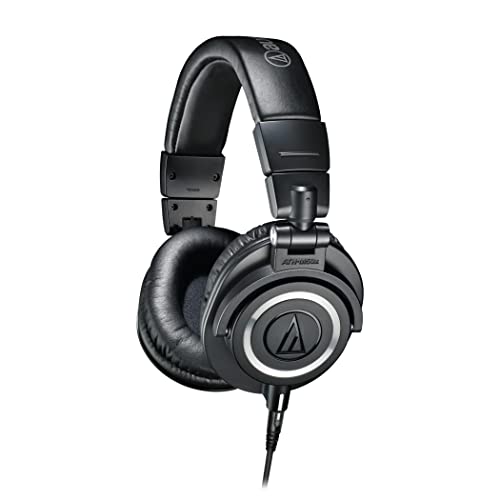
Audio-Technica ATH-M50x
The durable default. Not neutral, but consistent, and it survives being thrown in a bag.
- Extremely robust with a detachable cable
- Strong isolation in a compact folding design
- Widely supported with cheap replacement parts
- Elevated bass is not accurate for mixing
- Clamping force is high on larger heads

- Band
- $ Budget tier
Sony MDR-7506
The studio workhorse that has outlived several formats, and still costs very little.
- Revealing enough to catch problems while recording
- Every part is replaceable and cheap
- Folds down small and is nearly indestructible
- Pads are less comfortable over long sessions
- Coiled cable is heavy and gets in the way
Questions people ask
Why do I need closed-back headphones?
Because open-back designs leak sound outwards by design, and a microphone sitting a hand span from your face will happily record whatever is leaking from your headphones. The result is your own game audio or your co-host bleeding back into your recording, which is impossible to remove cleanly afterwards. Closed backs keep the sound in. If you never record with anything playing, this constraint disappears and open designs become worth considering for comfort.
Do I need an amplifier?
For most headphones in this range, no. Anything with a moderate impedance runs perfectly well from an audio interface, and interfaces are designed for exactly this. Higher-impedance versions of the same headphones do want more voltage than a laptop socket can supply, and will sound thin and quiet without it. Check which version you are buying: many popular models are sold in several impedance variants under one name, and the difference is not cosmetic.
How long before the pads need replacing?
Typically one to three years of regular use, depending on the material and how warm you run. Compressed pads are the usual reason a pair starts feeling uncomfortable and sounding different, because the distance from the driver to your ear changes as they flatten. This is worth checking before concluding you need new headphones: replacement pads cost a fraction of a new pair and restore both the comfort and the tonal balance.
Beyerdynamic DT 770 Pro
Closed, comfortable for hours, and built so the parts you wear out can be replaced.