
We have not tested these products. This comparison is reasoned from manufacturer specifications, documentation and warranty terms. How we test
If you buy through a link on this page we may earn a commission. Retailers do not pay for reviews or placement. Prices are shown as bands, never as figures — the live price is at the retailer. As an Amazon Associate I earn from qualifying purchases. How we make money
On this page
The short version
A dynamic capsule with both outputs, at a price where neither is normally offered.
See at Amazon — Samson Q2U (opens in a new tab)The entry condenser worth owning, if your room is quiet enough to deserve one.
See at Amazon — Audio-Technica AT2020 (opens in a new tab)The stretch purchase that ends the upgrade path rather than continuing it.
See at Amazon — Rode PodMic (opens in a new tab)Budget microphones are better than they have ever been, and the microphone is usually not what is wrong with home audio anyway.
Three free improvements before you spend
Get closer. A hand span from the capsule instead of arm’s length. This is the largest single improvement available and it costs nothing.
Speak slightly across it rather than straight into it. Plosive consonants lose most of their thump and you may not need a pop filter at all.
Put something soft behind you. A curtain, a rug, a full bookshelf. Bare parallel walls are what make a room sound like a bathroom, and breaking them up works better than any software.
Where the budget should go
An arm before a better capsule, essentially always. Then a dynamic microphone rather than a condenser, unless your room is genuinely quiet.
The Samson Q2U (at Amazon, opens in a new tab) is that dynamic at the bottom of the range, the Rode PodMic (at Amazon, opens in a new tab) is the one that ends the upgrade path, and the Audio-Technica AT2020 (at Amazon, opens in a new tab) is the condenser for a room that has earned one. The last two need an interface as well. If the budget stretches, the USB microphones we recommend follow the same dynamic-first reasoning.
How we chose
No recordings or measurements were made for this guide. It rests on capsule types and published polar patterns, on connectivity, and on how each microphone behaves in an ordinary untreated room.
The picks
 (opens Amazon in a new tab)
 - Band
- $ Budget tier
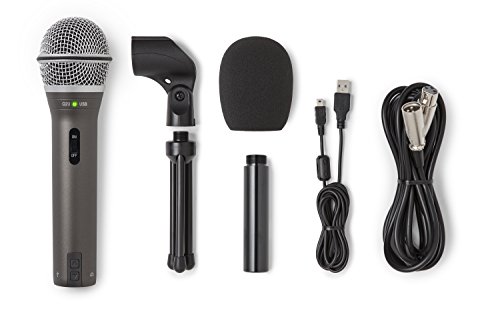
Samson Q2U
A dynamic capsule with both outputs, at a price where neither is normally offered.
- Dynamic capsule copes with a reflective room
- USB now, analogue later, same microphone
- Cheap enough to keep as a spare forever
- No onboard processing of any kind
- The bundled stand should be replaced immediately
 (opens Amazon in a new tab)
 - Band
- $ Budget tier
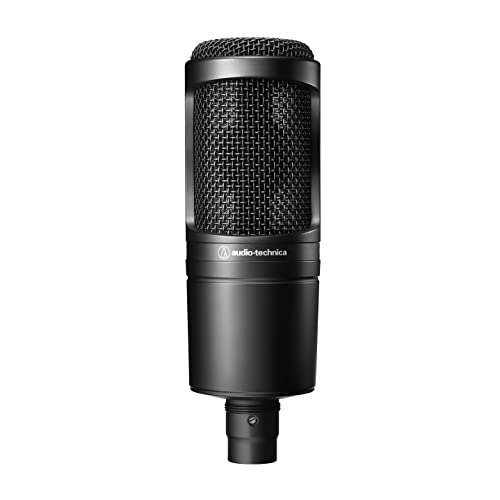
Audio-Technica AT2020
The entry condenser worth owning, if your room is quiet enough to deserve one.
- Genuinely detailed for the money
- Works with any interface supplying phantom power
- Light and easy to mount on anything
- Captures the room as faithfully as it captures you
- Requires an interface, so the real cost is higher
 (opens Amazon in a new tab)
 - Band
- $$ Mid tier
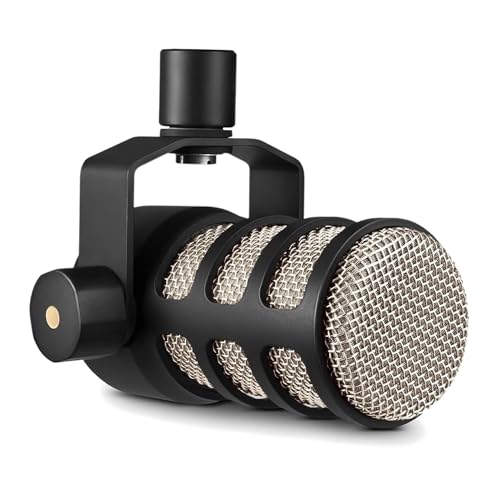
Rode PodMic
The stretch purchase that ends the upgrade path rather than continuing it.
- Works with ordinary interface gain
- Internal pop filter deals with plosives
- Will still be a good microphone in fifteen years
- Needs an interface and a sturdy arm
- Well above the budget bracket by itself
Questions people ask
Is a cheap microphone good enough to stream with?
Comfortably, and the microphone is rarely what makes home audio sound amateur. Distance, room reflections and background noise account for most of it, and all three are free to improve. A modest microphone used close, in a room with some soft furnishing, on an arm that isolates it from the desk, sounds better than an expensive one used badly at arm length in an echoing room. Fix position first and you may not need to spend more at all.
What should I buy before a better microphone?
A boom arm, without much hesitation. It gets the capsule close to your mouth at the right angle and stops keyboard and desk knocks travelling straight into it, which addresses two of the three usual problems in one purchase. After that, anything soft that breaks up the reflections in the room: curtains, a rug, a bookshelf behind you. Both of those change recordings more than moving up a tier of microphone.
Do I need a pop filter?
If plosive consonants are thumping, yes, and a cheap one solves it entirely. Many broadcast dynamic microphones have effective filtering built in and need nothing added. Condensers, and particularly cheap condensers, usually benefit. Before buying one, try speaking slightly across the microphone rather than directly into it: angling the capsule a little off-axis from your mouth removes most plosive energy for free and often makes the accessory unnecessary.
Samson Q2U
A dynamic capsule with both outputs, at a price where neither is normally offered.