
We have not tested these products. This comparison is reasoned from manufacturer specifications, documentation and warranty terms. How we test
If you buy through a link on this page we may earn a commission. Retailers do not pay for reviews or placement. Prices are shown as bands, never as figures — the live price is at the retailer. As an Amazon Associate I earn from qualifying purchases. How we make money
On this page
The short version
One microphone input done properly, with the extra gain mode that matters most here.
See at Amazon — Focusrite Scarlett Solo (opens in a new tab)The second input is worth the small step up more often than people expect.
See at Amazon — Focusrite Scarlett 2i2 (opens in a new tab)The cheapest interface worth owning, with the compromises exactly where you would expect.
See at Amazon — Behringer UMC22 (opens in a new tab)The budget end of this category has improved enormously, and the compromises that remain are specific and predictable.
What is no longer a compromise
Conversion. Even inexpensive interfaces convert cleanly enough that your room and your microphone are the limiting factors, not the analogue-to-digital stage. This was not true fifteen years ago and it is comfortably true now.
Driver stability, at least from established manufacturers. Class-compliant operation means most of these work with nothing installed at all.
What still is
Gain. This is the one that matters. Cheap preamplifiers run out of clean gain sooner, and the sound of running out is hiss under your voice. The Focusrite Scarlett Solo (at Amazon, opens in a new tab) is our pick because it addresses that directly, the Focusrite Scarlett 2i2 (at Amazon, opens in a new tab) does the same with a second input, and the Behringer UMC22 (at Amazon, opens in a new tab) is where you hear it first. The full Scarlett Solo review covers where it runs out, and the full interface roundup is where to look once gain is worth paying more for.
Headphone output. Adequate for monitoring, weak with demanding headphones.
Build. Plastic where the better ones are metal, and controls that feel it.
How we chose
No interfaces were measured or recorded through for this guide. It rests on published gain ranges and noise specifications, on connectivity, and on how each pairs with the microphones people commonly buy alongside them.
The picks
 (opens Amazon in a new tab)
 - Band
- $ Budget tier
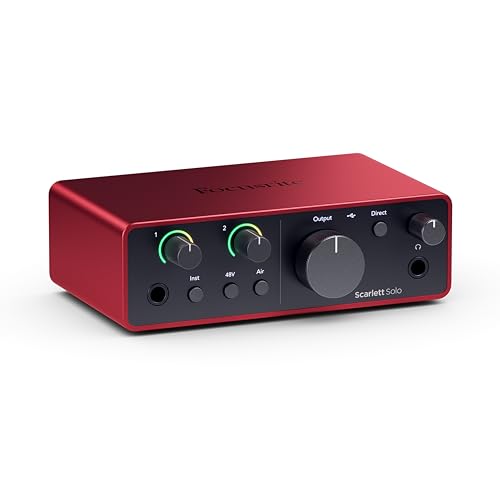
Focusrite Scarlett Solo
One microphone input done properly, with the extra gain mode that matters most here.
- Extra gain mode helps low-output microphones
- Well supported on every platform for years
- Compact and genuinely sturdy
- Only one microphone input
- Headphone output is basic
 (opens Amazon in a new tab)
 - Band
- $$ Mid tier
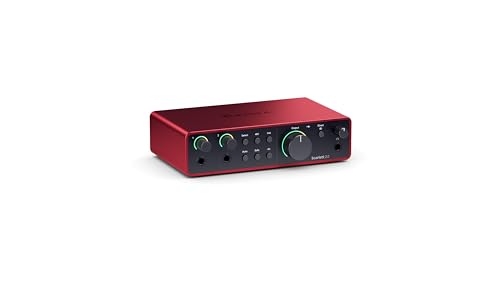
Focusrite Scarlett 2i2
The second input is worth the small step up more often than people expect.
- Two inputs on separate tracks
- Same extra gain mode as its smaller sibling
- Excellent long-term driver support
- Costs noticeably more than the single-input version
- Latency is unremarkable
 (opens Amazon in a new tab)
 - Band
- $ Budget tier
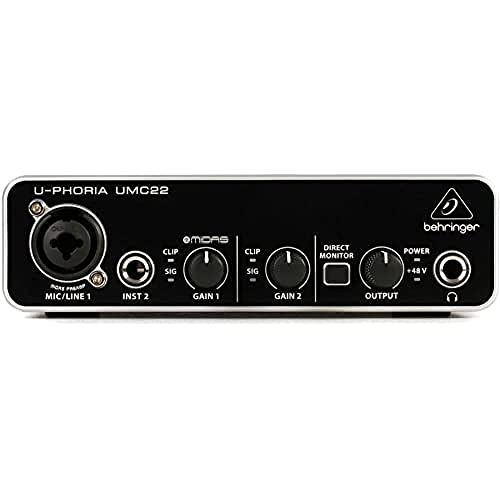
Behringer UMC22
The cheapest interface worth owning, with the compromises exactly where you would expect.
- Costs very little for a working signal chain
- Supplies phantom power for a condenser
- Small enough to leave permanently connected
- Limited gain struggles with low-output dynamics
- Higher noise floor than the alternatives
Questions people ask
What do cheap interfaces actually compromise on?
Preamplifier gain and noise, headphone output quality, and build. The converters are usually fine, because good conversion became cheap years ago and is no longer where manufacturers economise. What you notice in practice is that the gain runs out sooner with a quiet microphone, that the noise floor is a little higher when you push it, and that the headphone socket is weaker than a good pair of headphones would like.
Will a cheap interface work with any microphone?
It will work with any condenser, because condensers produce plenty of signal and only need phantom power, which every interface here supplies. Broadcast dynamic microphones with very low output are where cheap interfaces fail, and the failure is hiss rather than silence. If you own or want one of those, either budget for an interface with high-gain preamplifiers or plan for an inline booster as part of the purchase.
Is a USB microphone cheaper overall?
Usually yes, once you count the interface, the cable and the microphone as one purchase. A decent USB microphone frequently costs less than an entry interface plus an entry analogue microphone, and it sounds comparable. The reasons to take the separate route anyway are that you can upgrade one piece at a time, record two people on separate tracks, and keep the microphone through several computers.
Focusrite Scarlett Solo
One microphone input done properly, with the extra gain mode that matters most here.