
We have not tested these products. This comparison is reasoned from manufacturer specifications, documentation and warranty terms. How we test
If you buy through a link on this page we may earn a commission. Retailers do not pay for reviews or placement. Prices are shown as bands, never as figures — the live price is at the retailer. As an Amazon Associate I earn from qualifying purchases. How we make money
On this page
The short version
Holds a heavy broadcast microphone where you put it, for years, without re-tensioning.
See at Amazon — Rode PSA1+ (opens in a new tab)Sits low and flat, which keeps the microphone out of the camera frame entirely.
See at Amazon — Elgato Wave Mic Arm LP (opens in a new tab)Fine for a light microphone, and it will sag under anything heavier within months.
See at Amazon — InnoGear Microphone Boom Arm (opens in a new tab)An arm is the accessory that changes recordings most, and it is consistently the last thing people buy.
Why it matters more than the microphone
Position. It gets the capsule a hand span from your mouth at the right angle, which is the single largest improvement available to any recording.
Isolation. A desk stand conducts every keystroke and knock straight up into the capsule. An arm, particularly with a shock mount, does not.
It gets out of the way. You can push it aside when you are not talking, which means you will actually leave it set up. That matters on a streaming desk that already holds a monitor, a camera and perhaps a console capture card.
What separates a good arm from a cheap one
Spring quality, and therefore whether it still holds position in a year. Cable routing, which is the difference between a tidy desk and a cable draped across it. And the clamp, which decides whether it stays put when you nudge it.
That is the whole case for the Rode PSA1+ (at Amazon, opens in a new tab) over the InnoGear Microphone Boom Arm (at Amazon, opens in a new tab). The Elgato Wave Mic Arm LP (at Amazon, opens in a new tab) is the one to look at if the arm must stay out of the camera frame.
How we chose
No arms were loaded or tested here. This guide rests on published weight ratings and reach, on clamp and cable routing design, and on the mounting hardware included.
The picks
 (opens Amazon in a new tab)
 - Band
- $$$ Upper-mid tier
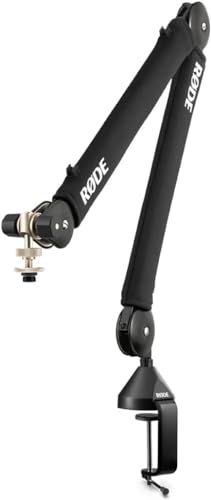
Rode PSA1+
Holds a heavy broadcast microphone where you put it, for years, without re-tensioning.
- Genuinely holds position under heavy load
- Internal cable routing keeps the desk clean
- Damped movement rather than springing about
- Costs as much as a decent microphone
- Overkill for a light USB microphone
 (opens Amazon in a new tab)
 - Band
- $$ Mid tier
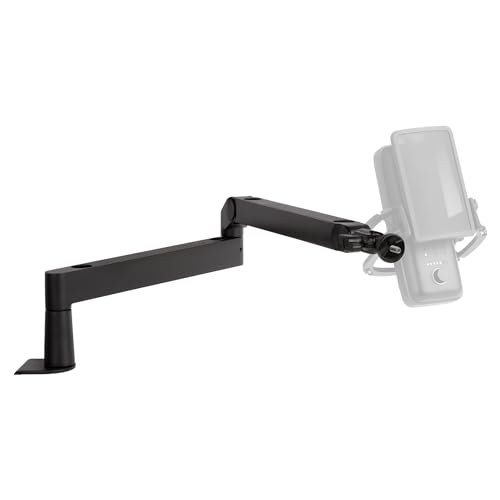
Elgato Wave Mic Arm LP
Sits low and flat, which keeps the microphone out of the camera frame entirely.
- Low profile stays below the camera frame
- Cables run inside the arm
- Smooth movement that stays where set
- Less reach than a conventional tall arm
- Weight rating below the heaviest microphones
 (opens Amazon in a new tab)
 - Band
- $ Budget tier
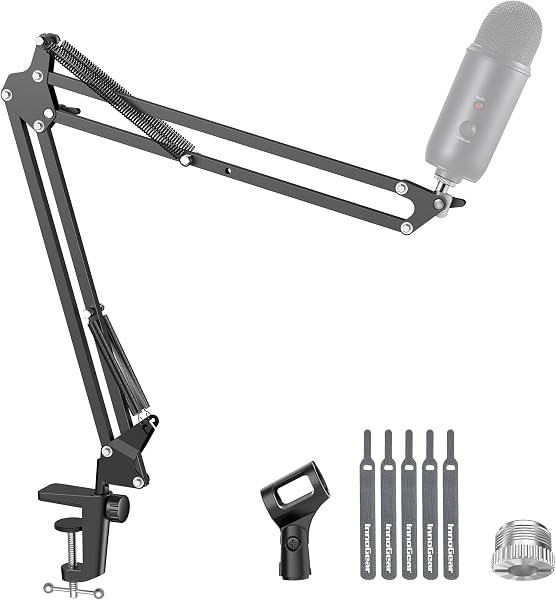
InnoGear Microphone Boom Arm
Fine for a light microphone, and it will sag under anything heavier within months.
- Costs a fraction of the alternatives
- Adequate for genuinely light microphones
- Includes the common mounting adapters
- Springs weaken quickly under real weight
- External cable routing looks untidy
Questions people ask
Why does my boom arm droop?
Because the springs are carrying more weight than they were designed for. Every arm has a weight range, and the bottom of that range matters as much as the top: too heavy and it sags, too light and it springs upward. A broadcast dynamic microphone with a shock mount weighs considerably more than people assume, and the weight most often quoted is the microphone alone rather than the microphone plus its mount and cable.
Will it damage my desk?
A clamp can mark a soft or veneered surface if it is overtightened, and the fix is trivial: put something between the clamp jaw and the desk. A folded cloth or a piece of thin rubber spreads the load and prevents the dent. The other consideration is the desk edge itself, since clamps have a maximum thickness and a thick or rounded edge may not accept one at all. Measure before ordering.
Do I need a shock mount as well?
It depends on the microphone. Some broadcast dynamics have shock mounting built into the body and need nothing added. Most condensers benefit clearly from one, because they are sensitive to the vibration that travels up an arm from a desk knock or a keyboard. Check what is included: many microphones ship with a rigid clip rather than a shock mount, and the two look similar enough that people assume they have one when they do not.
Rode PSA1+
Holds a heavy broadcast microphone where you put it, for years, without re-tensioning.